Yuba Mining and Machine
On-Site Testing and Plant Optimization
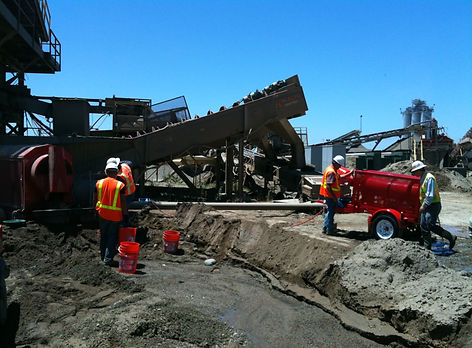
Bring the Equipment to the Material and Measure the Opportunity
Some recovery opportunities cannot be evaluated from a small shipped sample alone.
When an operation already has active material streams, stockpiles, concentrates, or processing equipment in place, Yuba Mining and Machine can bring demonstration equipment directly to the site and test the material under real operating conditions.
Our on-site testing programs are designed to determine whether recoverable gold is present, how much may be available in a specific material stream, and what type of recovery system may be practical for the operation.
Rather than relying only on assays or theoretical calculations, we process substantial quantities of material and allow the results to show what the opportunity may be.
demonstrate what can be achieved.
Testing Existing Concentrate and Material Streams
Many operating plants already produce streams that may contain recoverable gold but are not being fully evaluated.
We can test material from:
-
Jig concentrates
-
Jig tailings
-
Sluice concentrates
-
Sluice tailings
-
Shaker-table concentrates
-
Table tailings
-
Centrifuge concentrates
-
Sand-screw discharge
-
Classifier underflow or overflow
-
Dredge discharge
-
Screened sand products
-
Black-sand concentrates
-
Existing cleanup circuits
-
Plant tailings
-
Stockpiled material
Our equipment can be positioned alongside the existing plant so material can be collected from specific points and processed separately.
This allows us to compare different streams and determine where gold is concentrated, where it may be escaping, and which material is most suitable for additional recovery.
Gold-Recovery Evaluation for Sand and Aggregate Operations
Sand and aggregate operations often process large volumes of material from river channels, floodplains, dredge ponds, and historic placer areas.
Even when gold recovery is not part of the existing business, fine gold and heavy minerals may be present in one or more plant streams.
Yuba Mining and Machine can conduct an on-site evaluation to help determine whether adding a gold-recovery circuit may be feasible.
Potential test locations may include:
-
Dredge discharge
-
Sand-screw feed or discharge
-
Dewatering equipment
-
Classifier streams
-
Fine-sand products
-
Settling areas
-
Plant waste streams
-
Stockpiled sand
-
Concentrated heavy-mineral zones
The purpose of the test is not to assume that every aggregate plant contains economically recoverable gold. It is to process enough representative material to determine whether a measurable opportunity exists.
A Typical On-Site Testing Program
Most field-testing programs are completed over approximately one week, although the schedule may vary according to the site, material, and number of streams being evaluated.
During that period, we may process multiple tons of material through our mobile demonstration equipment.
A typical program includes:
1. Site and Process Review
We begin by reviewing the existing operation and identifying potential sampling points.
This may include observing:
-
Material flow through the plant
-
Existing recovery equipment
-
Feed rates
-
Classification
-
Water flow
-
Concentrate discharge
-
Tailings streams
-
Stockpile locations
-
Areas where heavy minerals appear to accumulate
The goal is to select material streams that provide meaningful information about the operation.
2. Representative Material Collection
Material is collected from selected points over enough time to account for normal plant variation.
A single bucket may not represent a production stream that changes throughout the day. Where practical, we collect or process larger composite samples so the results are based on meaningful material volumes.
3. Mobile Equipment Setup
We bring the appropriate testing equipment to the site and establish a temporary processing circuit.
Depending on the project, this may include:
-
Reverse Multi-Helix Spiral equipment
-
Low-G Horizontal Centrifuge equipment
-
Feed hoppers
-
Pumps and water systems
-
Classification equipment
-
Concentrate collection
-
Mobile support equipment
The circuit is selected according to the material being tested and the questions the customer wants answered.
4. Processing Under Field Conditions
We process multiple tons of material where sufficient feed is available.
The equipment may be adjusted during the test to evaluate:
-
Broad versus tight separation
-
Different feed rates
-
Different water settings
-
Multiple material streams
-
Repeated test runs
-
Cleaner and Finisher performance
-
Concentrate volume
-
Gold recovery consistency
Processing larger quantities helps reduce the risk of drawing conclusions from a small or unusually rich sample.
5. Gold Recovery and Concentrate Evaluation
Recovered concentrate is cleaned and evaluated.
Depending on the project and available material, we may estimate recovery in terms such as:
-
Gold per ton
-
Gold per cubic yard
-
Gold per hour of plant production
-
Gold per selected material stream
-
Concentrate produced per ton
-
Relative grade between sampling points
Identifying the Best Recovery Point
One of the most valuable results of on-site testing is determining where a new recovery stage should be installed.
The highest-value stream is not always the most obvious one.
For example:
-
A jig concentrate may already be highly enriched but represent very little total material.
-
A sand-screw discharge may contain a lower grade but provide a large, consistent production stream.
-
A tailings stream may contain enough fine gold to justify a scavenger circuit.
-
A black-sand stream may contain recoverable gold but require staged spiral cleaning.
-
A final concentrate may only need a Spiral Finisher rather than a complete new plant.
By testing individual streams, we can help identify the best balance between grade, volume, accessibility, and processing cost.
Existing Plant Optimization
On-site testing can also be used to evaluate and improve existing recovery equipment.
Many plants operate jigs, sluices, tables, classifiers, or other gravity equipment that may no longer be properly adjusted for the current feed.
Performance can change because of:
-
Different material characteristics
-
Increased production rate
-
Worn components
-
Incorrect stroke or pulse settings
-
Poor water distribution
-
Inconsistent feed
-
Improper classification
-
Excessive concentrate loading
-
Changes made over years of operation
We can observe the equipment in operation, sample material before and after individual stages, and help determine whether the equipment should be adjusted, repaired, supplemented, or replaced.
Tune, Supplement, or Replace Existing Equipment
Not every plant problem requires a complete replacement.
Depending on what testing shows, the most practical recommendation may be to:
-
Adjust an existing jig
-
Correct water flow
-
Improve feed distribution
-
Change classification
-
Modify a sluice setup
-
Add a scavenger recovery stage
-
Install a Low-G Horizontal Centrifuge
-
Replace an underperforming concentrator
-
Redirect a valuable material stream
-
Add parallel equipment for greater capacity
Our objective is to improve the performance of the overall circuit, not simply to sell the largest amount of new equipment.
Where existing equipment can be tuned and retained, we will recommend that approach. Where a missing or underperforming stage is limiting recovery, we can propose a practical modification.
What the Customer Receives
Following the field test, we prepare a report summarizing the work performed and the results observed.
Depending on the scope of the project, the report may include:
-
Site and plant overview
-
Material streams tested
-
Approximate quantities processed
-
Equipment used
-
Test procedures
-
Recovered gold or concentrate
-
Estimated gold per ton or cubic yard
-
Comparisons between material streams
-
Observed plant-recovery issues
-
Equipment-setting recommendations
-
Suggested plant modifications
-
Recommended recovery equipment
-
Preliminary layout or process-flow recommendations
-
Suggestions for additional testing
The report is intended to help the customer decide whether a recovery opportunity is worth pursuing and what the next practical step should be.
From Field Test to Permanent Installation
A successful field test can provide the basis for a permanent recovery system.
Once we understand:
-
Which stream contains the recoverable gold
-
How much material is available
-
How the material responds to concentration
-
The expected concentrate volume
-
The available plant space
-
Water and power requirements
-
Existing equipment limitations
we can recommend or design an installation around the actual operation.
This may involve a single Spiral Finisher, a Low-G Centrifuge, a staged Spiral Bank, a scavenger circuit, or a complete custom recovery plant.
Test the Real Operation
A small sample can provide useful information, but an on-site test shows how the material behaves at the plant, across real production shifts, and in the streams that are actually available.
Yuba Mining and Machine can bring the equipment to your operation, process meaningful quantities of material, evaluate the recoverable gold, and help determine whether a permanent recovery system is feasible.